
How to Make a Really Good Pour Over
(Even If You're New to This)
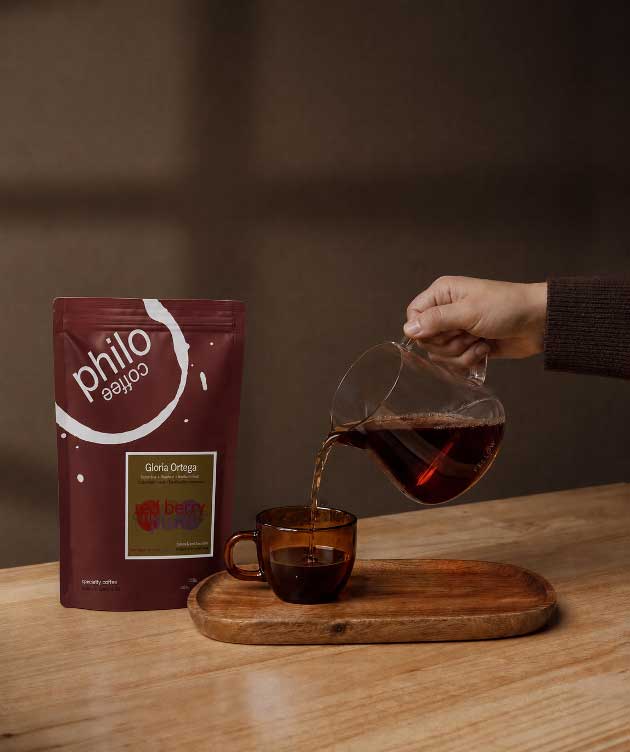
Inspired by our Gloria Ortega from Colombia — a washed Pink Bourbon/Caturra that rewards patience and precision with a cup that keeps changing as it cools.
Inspired by our Gloria Ortega from Colombia — a washed Pink Bourbon/Caturra that rewards patience and precision with a cup that keeps changing as it cools.
Let me be honest with you about something: pour over coffee has a reputation for being fussy, precious, and reserved for people who own expensive grinders and have opinions about kettle spout diameter. That reputation is at least partially deserved. But it's also not the whole story.
The whole story is that pour over coffee, when it works, is one of the most satisfying things you can make at home — not because it's complicated, but because you're actually in control of the result. You can taste the difference between a good bloom and a lazy one. You can feel when the pour is going right. And when you nail it, the cup tells you.
We've been playing with our V60 recipe here at Philo for a while now, and we keep coming back to an approach that's been quietly developed and tested by Lance Hedrick — one of the sharpest brewing minds in the specialty world and, crucially, someone who actually explains why things work rather than just telling you what to do. His most recent method is designed for any dripper, any coffee, and any grinder. That last part matters.
Here's how we're doing it.
What You Need
- 15g of coffee, ground medium-fine (think: slightly coarser than table salt — not powder, not chunks)
- 225g of water for light roasts / 220g for medium / 210g for dark
- Temperature: 93–96°C for light roast, 90–93°C for medium, 88°C for dark
- A V60, Kalita, or any pour over dripper you have
- A paper filter, a scale, and a timer
- A gooseneck kettle helps a lot — but work with what you've got
A note on temperature: these aren't arbitrary numbers. Light roast beans are physically denser, meaning water has to work harder to pull out their sugars and acids. Hotter water gives you the extraction energy you need. Dark roasts are already porous from the roasting process — cooler water prevents over-extraction and bitterness.
If you're brewing our Gloria Ortega — a washed Pink Bourbon/Caturra from her farm El Progreso in Sevilla, San Agustín, Huila, grown at 1,870 to 1,920 masl — you're working with a medium-light roast: we'd start at 92–93°C and see where that lands. (Quick note: you may notice the bag says "medium" — we actually adjust our roast degree slightly after each release as we dial things in, so Gloria currently sits a touch lighter than the label suggests. We know, we know. We're working on keeping that clearer.)
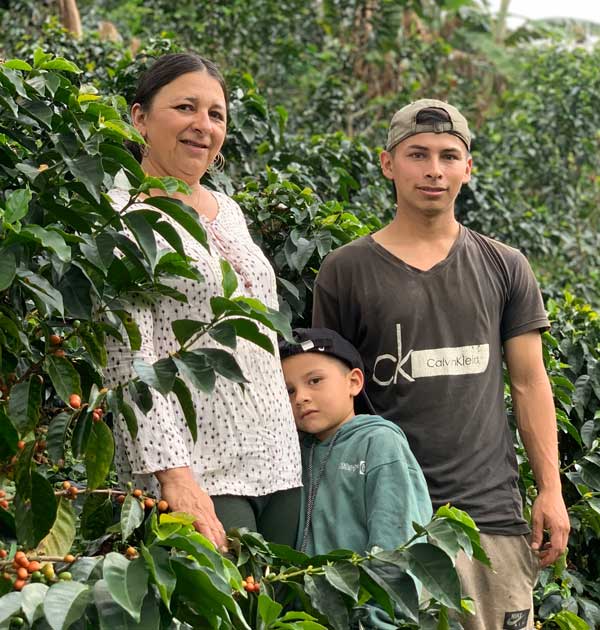
Gloria with two of her children at El Progreso, San Agustín, Huila — 1,870 to 1,920 masl.
The red berry, plum, and chocolate you'll find in the cup are the result of Gloria's work — and her two dry fermentations, 24 hours and then 48 hours in majolica tanks, before a slow 15 to 20 day dry. She rebuilt El Progreso from the ground up in 2020, replanting 1,100 Pink Bourbon trees after a period of real hardship. It's worth taking your time with it.
The Method
Rinse your paper filter with hot water and dump it out. This removes any papery taste and preheats the dripper — both matter more than most people think.
Add 15g of coffee and gently level the bed. Flat is the goal. A lumpy, uneven bed extracts unevenly, which means some parts of your coffee are over-extracted while others haven't given you anything useful yet.
0:00 — Bloom — Pour 45g of water (3× your coffee dose) slowly and evenly over the grounds. Give the dripper a gentle swirl to make sure everything is saturated. Then watch.
This is the part most people rush, and it's worth slowing down for. The bloom releases CO₂ that's been trapped in the coffee since roasting — a fresh, well-rested coffee will bubble and heave noticeably here. If the bed looks dry and cracked after 20–30 seconds, that's a sign there's still a lot of gas to release: add another small pour (15–25g) before moving on. If it looks wet and bubbling consistently, you're good to proceed at 0:30.
0:30 — First pour — Bring the total weight to 75g in a slow, steady spiral from the center outward.
1:00 — Second pour — Bring total to 150g the same way.
1:30 — Third pour — Bring total to your target weight (225g for light, adjust slightly for medium and dark).
Now let it drain. The goal is for the drawdown to finish somewhere around 3:00–3:30. That's your dial.
If the coffee drains in under 2:30, go finer on your next brew. If it's still going at 4:00+, go coarser. The grind size is the adjustment lever — not the pour speed, not the ratio. Change one thing at a time and taste the result.
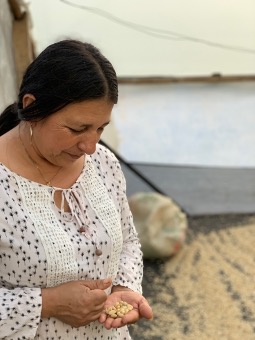
Gloria inspecting her green beans at the drying station — 15 to 20 days of careful drying after a 72-hour double fermentation.
What to Look for in the Cup
This is the part that matters most, and it's the part nobody talks about enough: don't evaluate your coffee at the first sip. Let it cool.
A well-extracted pour over reveals different things at different temperatures. At near-scalding, you might get sweetness and body. As it drops to 60°C, the fruit or floral notes open up. By the time it's closer to room temperature, you start to taste the finish — and that's where you'll learn whether your extraction is working. A coffee that only tastes good hot is usually masking something. A coffee that's still interesting at room temperature? That's the target.
If the cup tastes hollow or sour, extraction is too low: go finer or hotter. If it's bitter or harsh, you've gone too far: go coarser or cooler. If it tastes balanced, sweet, and keeps changing as it cools — you did it.
We love this recipe because it works across our whole lineup — from the brighter, more delicate lots we get through Semilla to richer, lower-acid naturals. The variables are honest and the feedback is immediate. Pour over isn't about perfection; it's about paying attention. Try it with any coffee you have on hand, and let us know what you taste.
If you want to brew through something specific from us and want help dialling in your parameters, reach out — we're always happy to nerd out over this stuff together.
→ Shop Gloria Ortega and our full lineup at philocoffee.ca
Happy brewing. — Phil
Frequently Asked Questions
Do I need a gooseneck kettle for pour over coffee?
It genuinely helps — the narrow spout gives you control over flow rate and pour placement. That said, a steady hand and a regular kettle can absolutely work. Start with what you have and upgrade if you find yourself enjoying the process.
What grind size should I use for a V60?
Medium-fine is the starting point — think slightly coarser than table salt. The real guide is your drawdown time: if the brew finishes before 2:30, go finer. If it's still dripping past 4:00, go coarser. Let the clock tell you.
How much coffee do I use for pour over?
We use 15g as our base, brewed with 220–225g of water (a 1:15 ratio). That's a solid, balanced starting point — not too strong, not too thin. Adjust up or down by a gram or two to match your taste.
Why does pour over coffee taste different as it cools?
As temperature drops, different flavour compounds become more perceptible. A well-extracted coffee gets more interesting as it cools — sweetness opens up, fruit notes sharpen. If it falls apart at room temperature, that's useful feedback: there may be an extraction issue worth dialling in.
What's the difference between a V60 and a Kalita Wave?
Both are excellent pour over drippers, but they behave differently. The V60's single large hole and spiral ribs create a faster flow that rewards precision in your pour. The Kalita's flat bottom and three small holes slow things down and are a little more forgiving. This recipe works with either — just expect slightly longer drawdown times on the Kalita.